Car Repair Invoice in Dubai
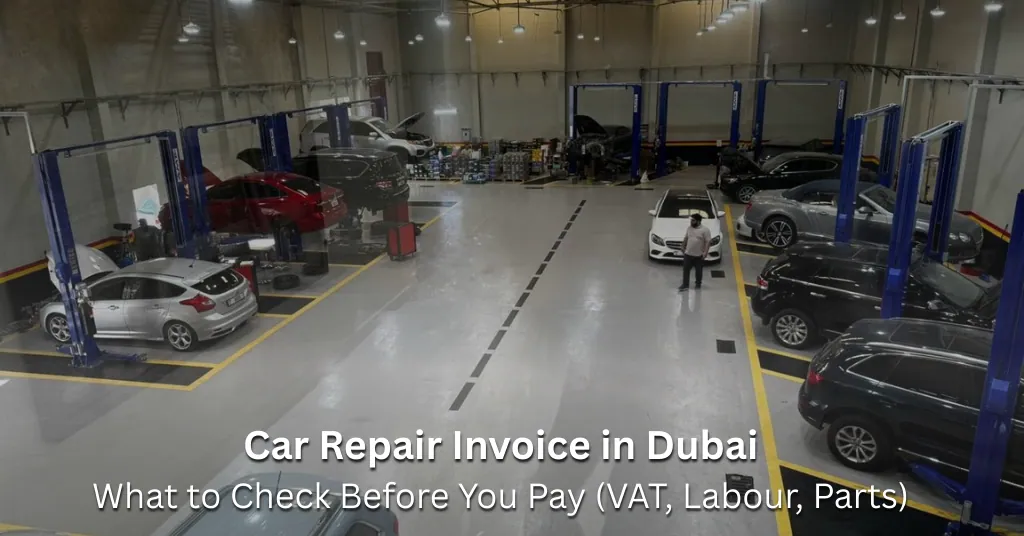
Getting your car serviced or repaired in Dubai can be costly, especially when you receive an invoice filled with unfamiliar terms. Dubai’s automotive sector is highly regulated, yet many drivers struggle to make sense of the tax, labour charges and parts pricing that appear on their repair bills. Understanding what should appear on a legitimate invoice is essential to avoid paying more than necessary and to ensure compliance with regulations such as the UAE’s Value Added Tax (VAT) law.
This post explains what to look for on a car repair invoice in Dubai, how VAT is applied, how labour and parts should be itemised, and how to protect yourself against surprise fees or fraudulent charges. For vehicle owners who manage personal budgets or businesses that operate fleets, these tips will help you maintain transparency and accuracy in your car maintenance costs.
Why invoices matter
A car repair invoice is more than a receipt; it is a legally mandated record of the service provided. The Federal Tax Authority requires automotive businesses to issue a tax invoice for every sale or service subject to VAT. According to the UAE’s VAT guide for car dealers and service centres, the invoice must clearly show that VAT was charged at the standard rate and include all other information required by law. For invoices under AED 10,000 or when the customer is not VAT‑registered, a simplified invoice can be issued, but it still needs to state the VAT amount and basic transaction details. Correct invoices protect both the customer and the workshop: they enable the client to claim warranties, help the workshop document its taxable supplies, and, when properly structured, reduce disputes over payments.
From an accounting perspective, invoices also form the basis for financial records. Businesses that maintain fleets often partner with accounting services in Dubai to ensure that their car maintenance costs are accurately recorded and that VAT inputs are reclaimed where appropriate. A clear invoice reduces the burden on accounting teams by making each charge traceable.
Understanding VAT on repairs and parts
Since January 2018, the UAE applies a 5 per cent VAT to most goods and services, including automotive repair. The VAT Guide for car dealers explains that a tax invoice must state that VAT was charged at the standard rate. For repairs carried out under warranty, the situation can be confusing: if the customer pays for an extended warranty or services, VAT is due on that additional payment.
However, when repairs or parts are provided free of charge under a manufacturer warranty and the manufacturer pays the workshop for the work, VAT is still charged at the standard rate as long as the repair is done in the UAE. To avoid misunderstanding, ensure the invoice explains whether the repair was covered by a warranty, who paid for it, and how VAT was calculated.
Key elements of a VAT‑compliant invoice
A proper car repair invoice should include the following sections:
- Workshop details: name, trade license number and VAT registration number.
- Customer details: name, vehicle registration number, and contact information.
- Description of services: each service performed (e.g., oil change, brake replacement) with quantity or labour hours, unit price and total price.
- Parts listing: clear description of each part installed, whether OEM or aftermarket, along with part numbers and pricing.
- Labour charges: number of hours spent, hourly rate and total labour cost.
- Consumables and diagnostic fees: some workshops charge for fluids, cleaning supplies or diagnostic scans; these should be itemised.
- VAT amount: the subtotal of parts and labour multiplied by 5 per cent. The invoice should show the VAT amount separately from the net total.
- Total due: final amount including VAT.
If the customer purchased a service package or coupon, the invoice should reference that package and indicate which services were redeemed during the visit. A well‑structured invoice makes it easier to verify that all items are legitimate and that no hidden fees are included.
Checking labour charges
Labour is often the most significant component of a repair bill. According to an Abu Dhabi car repair guide, workshop pricing generally comprises labour charges billed per hour, spare parts and materials, diagnostic fees and consumables. Premium European vehicles may command higher labour rates due to specialised tools and expertise, but there is still a difference between fair pricing and overcharging. Unscrupulous workshops sometimes inflate labour hours or add generic tasks such as “system check” or “fluid top‑up” that were never performed.
To protect yourself, follow these steps:
- Request an itemised labour breakdown. Ask for the exact number of hours spent on each task. If multiple mechanics worked on your car, the invoice should reflect their combined labour time rather than charging the full rate for each mechanic simultaneously.
- Compare labour rates. Contact two or three workshops and request quotes for the same repair. A guide on avoiding overpriced bills recommends comparing market rates to spot excessive estimates. Many workshops now offer free online quotes.
- Know your maintenance schedule. Your owner’s manual lists the recommended service intervals. If a mechanic suggests additional work, ask how it fits into the manufacturer’s schedule and whether it is critical.
- Request old parts back. When parts are replaced, ask to see or take home the used components. This ensures that replacements were actually made and deters fraudulent charges.
- Keep a record of services. Maintaining a log of past repairs and invoices prevents duplicate services and helps technicians understand your vehicle’s history.
Evaluating parts and materials
The parts section of your invoice should list each component replaced, the quantity used, the part number and whether it is OEM (original equipment manufacturer), aftermarket or refurbished. Some workshops mark up genuine parts far above retail value. To avoid paying inflated prices:
- Research part prices. Check online or contact authorised dealers to determine the retail price of major components.
- Check part numbers. A genuine part will have a manufacturer’s label or part number. If the invoice lists “fuel pump” without a part number, ask for details.
- Beware of unnecessary replacements. Some mechanics may suggest replacing entire assemblies when only a component is worn. Request to see the fault and ask if a repair is possible.
- Verify warranty coverage. Legitimate parts come with a warranty. The invoice should state the warranty duration on parts and labour. A guide on trustworthy workshops notes that reputable service centers provide warranties on both parts and labour.
Spotting hidden fees
Hidden or “miscellaneous” fees are a common way to increase a bill. These might include vague charges for shop supplies, environmental disposal or administrative fees. The Abu Dhabi guide warns that some bills list “miscellaneous” items with unclear pricing. The Dubai scams guide also notes inflated labour costs and bait‑and‑switch tactics where low‑cost services suddenly require expensive add‑ons. To avoid hidden fees:
- Ask for a written estimate before work begins and insist that any additional charges be approved by you.
- Decline unnecessary add‑ons such as engine flushes or injector cleanings unless a diagnostic scan confirms an issue.
- Verify consumable charges. If you see a flat fee for shop supplies, ask for a breakdown of what that includes.
Resolving disputes
If your final bill is significantly higher than the estimate, or if you suspect you were overcharged, there are steps you can take. The Abu Dhabi guide recommends asking for an itemised breakdown of labour hours, part numbers and costs; comparing with market rates; speaking to the manager; keeping all documentation; and filing a complaint with consumer protection authorities if necessary. Dubai’s consumer protection department investigates complaints about unfair pricing or fraudulent practices. Having a detailed invoice and records of communications will strengthen your case.
Conclusion
A car repair invoice in Dubai should be transparent and VAT‑compliant. Check that VAT is clearly stated, labour hours are detailed, parts are listed with part numbers and warranties, and that no hidden fees are included. Compare quotes, know your vehicle’s maintenance schedule, and retain old parts for verification. Comprehensive records will protect you against overcharging and simplify accounting for both individuals and businesses. When in doubt, consult a trusted mechanic or an accounting specialist familiar with automotive expenses in Dubai. By understanding what to look for on your invoice, you can confidently pay only for what you genuinely need.
Need a trusted garage in the UAE?
Book expert car service with 800Sayara in Dubai, Abu Dhabi and Sharjah.
Book Appointment